






Rethinking Retirement: Why Some Experts Say Indexed Universal Life Beats a 401(k)
Ciera Peters | The Liquidity Journal | Q3 2025
Our current landscape of economic uncertainty, rising taxes, and market volatility, has affluent professionals and small business owners increasingly looking beyond traditional retirement vehicles. At the center of this shift is a growing comparison between Indexed Universal Life (IUL) insurance and the traditional 401(k) plan. Do traditional retirement vehicles like 401(k)s still make sense? IUL Godfather, Doug Andrew, has long argued “no,” and in a recent reaction video, wealth strategist Randolph Love Ill, ChFC®, CPCU®, CLU® doubled down on that sentiment; explaining why more sophisticated savers are turning to Indexed Universal Life Insurance (IUL) instead.
The 401(k) has long been the go to retirement vehicle, primarily due to its employer match and tax-deferred growth, but sentiments are changing. Andrew references an article in TIME Magazine that asserts 401(k)s are “a rotten repository for our retirement reserves”. That may sound provocative, but the logic behind it is difficult to ignore. While it’s widely used, the 401(k) was designed under assumptions that retirees would be in a lower tax bracket. Contributions are made with pre-tax dollars, reducing taxable income today, and growing tax-deferred until retirement withdrawals begin, but as we all know, most people are not in a lower tax bracket when they retire,” contrary to the traditional financial planning narrative. Love amplifies this by likening deferred taxation to rising rent in Atlanta: "It never goes down."
By deferring taxes, retirees often find themselves in higher brackets later, without the deductions they enjoyed during their working years (e.g., mortgage interest or retirement contributions). The result? More taxes, not less. Perhaps the most interesting analogy from the discussion is the notion of Uncle Sam as a “permanent tax lien holder” on your 401(k). According to Andrew and echoed by Love, a third of your savings, yes 33%, could be taxed away upon withdrawal. That employer match? It may only be enough to cover the tax burden. Andrew calls this a false sense of security: “What a great partnership! Until you realize the government gets a third of every dime.”
Another key disadvantage lies in Required Minimum Distributions (RMDs). At age 73, retirees must start withdrawing from their 401(k)s whether they need the money or not or face a 50% penalty. This forced liquidation can disrupt tax planning, impact Medicare eligibility, and ruin strategies designed for wealth transfer.
What about Roth 401(k)s? Andrew concedes that Roth 401(k)s are better than traditional ones, but still stops short of calling them ideal. His “Laser Fund” concept is essentially a well designed IUL that takes top honors for tax efficiency, liquidity, and legacy planning. Love agrees: “A Roth is better. But is it best? I don’t know. IULs make a strong case.”
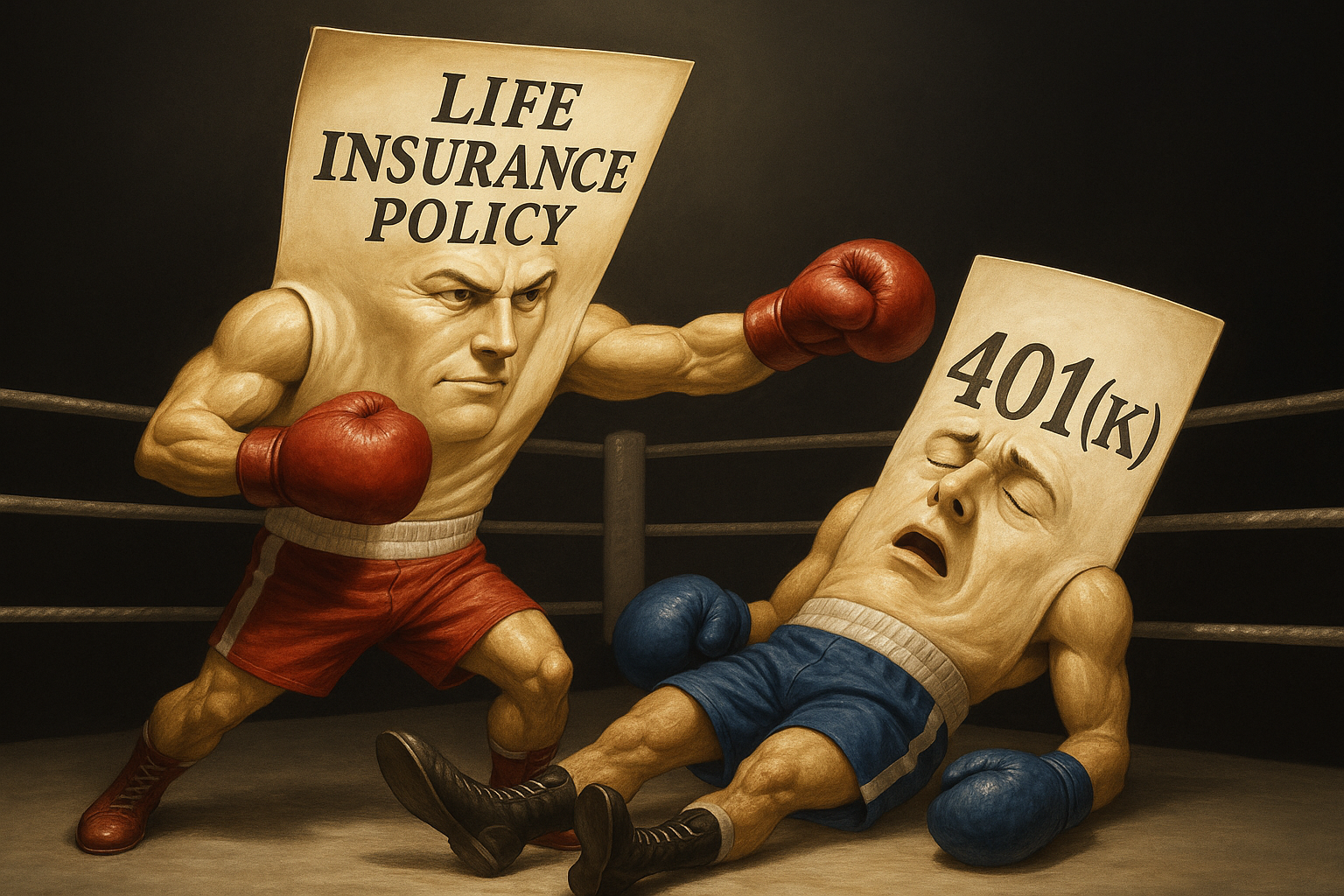
Doug Andrew and Randolph Love suggest that a properly structured and max funded Indexed Universal Life policy offers a compelling alternative. It combines permanent life insurance with the ability to grow cash value based on the performance of a stock market index, like the S&P 500, without direct market participation. 401(k)s however, including Roths are directly tied to market performance and can suffer heavy losses during downturns. IULs, by contrast, offer a floor (typically 0%), meaning you don’t lose money even when the market does, have downside protection from the market. IULs grow cash value tax-deferred, allow tax-free withdrawals through policy loans (if structured properly), and no income taxes on death benefits for estate planning or legacy goals. With a 401(k), access to funds is restricted until retirement age, unless you pay penalties or take loans. IULs offer more flexibility, allowing access to accumulated cash value at any time, for any reason, without triggering taxes or penalties. In Love’s words: “Don’t think about what it is, think about what it does. It’s not just life insurance. It’s a retirement freedom tool.”
For many, the best path forward may not be a binary choice but a hybrid strategy, contributing enough to a 401(k) to earn the match, then channeling additional savings into IULs for tax-free growth and liquidity. As both experts emphasize, strategic thinking, not conventional wisdom, is what separates retirement success from regret."
"Are you planning your retirement...or Uncle Sam’s?" Andrew asks. It’s a question every investor must consider.
For more information on Indexed Universal Life Insurance, schedule an appointment with Randolph Love III.