



Why Executives Leaders Are Drowning in Activity While Starving for Traction
Ciera Peters | The Liquidity Journal | Q2 2026
There has never been a time in modern business when people were more connected, more responsive, or more available. And yet, many leaders end their days with the same lingering feeling:
I worked nonstop, but I’m not sure I moved anything meaningful forward.
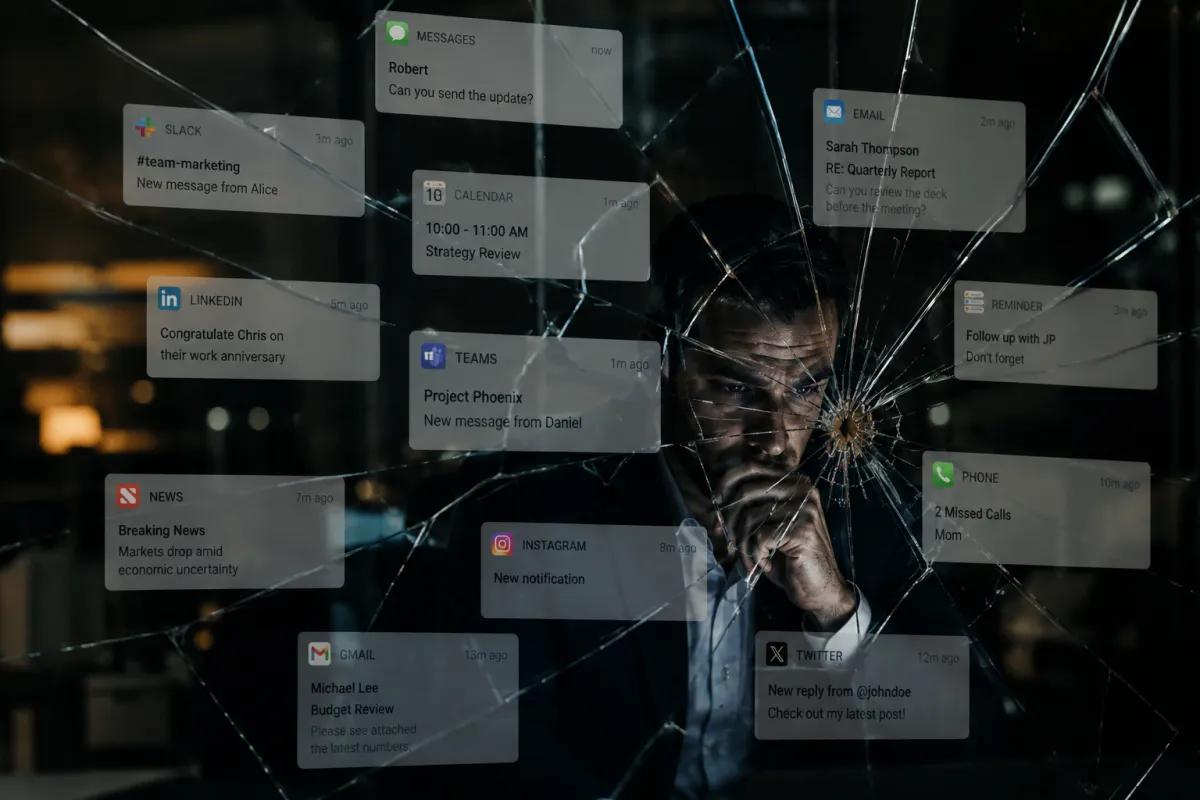
The calendar was full. The inbox was answered. Meetings happened. Notifications were cleared. Tasks were checked off.
Still, something feels unfinished.
Not because there was no activity, but because activity and progress are not the same thing. Modern professionals are drowning in motion while starving for traction.
Somewhere along the way, busyness became a status symbol. A full schedule began to represent ambition. Constant responsiveness became associated with leadership. Hustle culture reinforced the idea that exhaustion was evidence of commitment.
But being busy is not the same as being productive. In many cases, it is the opposite.
As author and behavioral design expert Nir Eyal has explained, distraction is not simply doing something unproductive. Distraction is doing anything that pulls you away from what you intended to do.
That distinction changes everything because it means you can spend an entire day doing work-related tasks and still be deeply distracted.
Responding to emails instead of building strategy. Sitting in meetings instead of making decisions or actually doing the work. Constantly reacting instead of intentionally creating.
The work may look productive from the outside, but if it prevents meaningful progress, it is still distraction. This is the hidden productivity crisis affecting modern leadership.

Most professionals are not struggling with laziness. They are struggling with fractured attention. The modern workplace rewards visibility. Fast replies signal engagement. Packed calendars signal importance. Constant availability signals dedication, but the most meaningful work rarely happens in reactive environments.
Strategic thinking requires uninterrupted thought. Creative problem solving requires mental space. Vision requires silence long enough to hear it.
Unfortunately, silence has become uncomfortable for many people. We reach for notifications during moments of uncertainty. We check messages between tasks. We multitask during conversations. Even moments meant for reflection are often filled with stimulation. Attention has become fragmented into dozens of micro-interruptions throughout the day.
And while each interruption may seem harmless on its own, the cumulative effect is significant. Deep focus is replaced with constant context switching. Momentum disappears. Work becomes reactive instead of deliberate. Many leaders no longer struggle with workload. They struggle with uninterrupted thought.
There is also a deeper layer to this conversation that many professionals quietly avoid confronting. Sometimes "busyness" is not just operational. Shallow work offers immediate gratification. Emails provide quick completion. Meetings create the feeling of momentum. Constant responsiveness creates the illusion of importance.
Deep work is different, because it forces difficult questions:
Is this the right strategy?
What actually matters most right now?
What if this fails?
What if I am building the wrong thing?
What deserves my full attention?

Those questions require stillness, honesty, and clarity. Constant activity can become a way to avoid them. Being busy can act as emotional insulation. If every moment is occupied, there is never enough space to examine whether the work itself is producing meaningful outcomes.
That does not mean hard work is unnecessary. Ambition still matters. Execution still matters. Discipline still matters. But motion without direction eventually becomes exhaustion.
A company can be busy without being effective.
A team can be active without being aligned.
A leader can be overwhelmed without being productive.
The goal is not to eliminate activity. Business will always demand movement, communication, and execution. The goal is to ensure activity remains aligned with intention. That requires something increasingly rare in modern leadership:
protected attention.
Not every notification deserves urgency and not every task deserves immediate response. Some of the highest-value work in business is invisible. Thinking, prioritizing, strategizing, creating, reflecting. Making fewer but better decisions. These things rarely produce instant dopamine. They do not always look impressive in real time. They cannot always be measured by visible activity.
But they create traction.
Americans have become obsessed with speed and responsiveness that focus has quietly become a competitive advantage. The leaders who create meaningful progress are often not the ones doing the most. They are the ones most intentional about where their attention goes because productivity is not measured by how full your day feels.
It is measured by whether your attention was invested in what mattered most.