








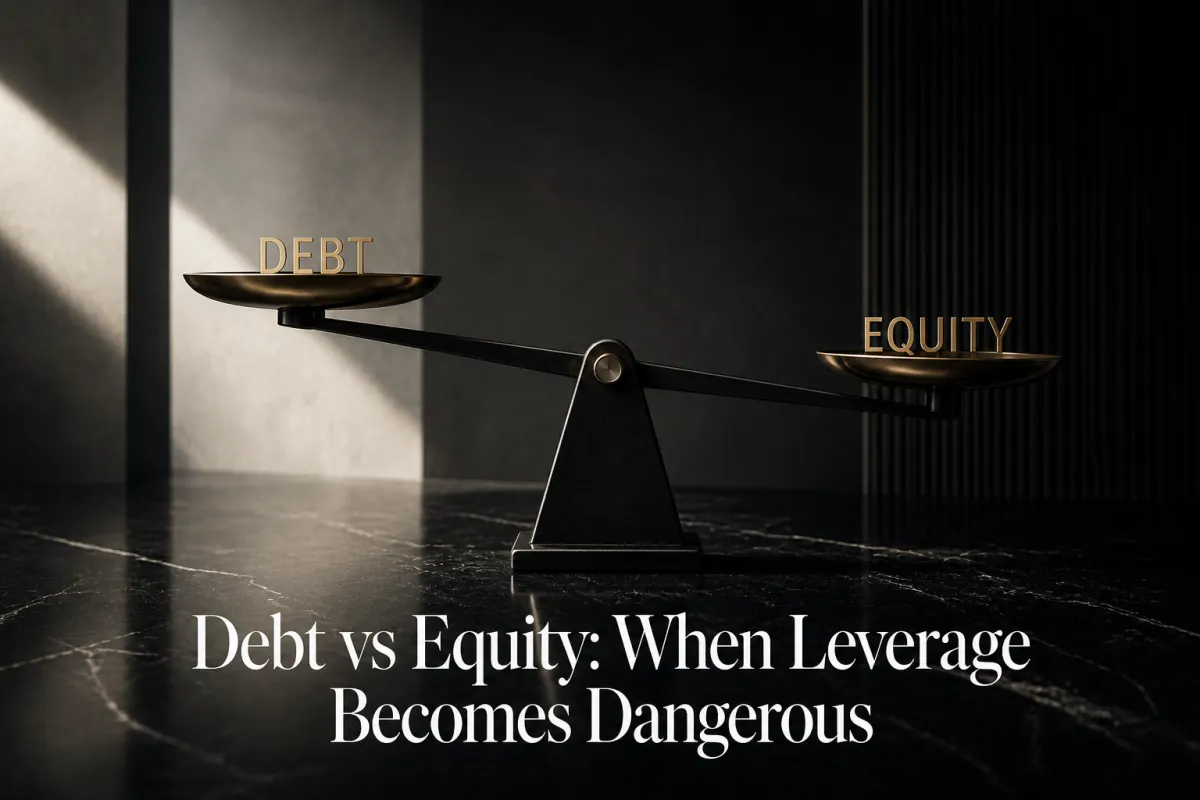
Debt vs Equity: When Leverage Becomes Dangerous
Ciera Peters | The Liquidity Journal | Q2 2026
In This Article:
At a certain stage of growth, the question is no longer whether to use capital, but what kind.
Revenue is moving. Opportunities are expanding. The ceiling feels higher than your current resources can reach. And somewhere in that gap, leverage enters the conversation.
Debt or equity.
On paper, it looks like a financial decision. In practice, it is a reflection of how a business is built, how it behaves under pressure, and how disciplined its leadership really is.
“Debt amplifies discipline or exposes its absence.”
That is where this conversation begin
The Seduction of Speed
Leverage promises acceleration.
Debt allows you to retain ownership while accessing capital. Equity allows you to bring in partners and scale beyond what your balance sheet alone can support. Both can be powerful. Both can be dangerous.
At the growth stage, the risk is not ignorance. It is overconfidence.
You have proof of concept. You have traction. You may even have a few wins that came faster than expected. That momentum creates a subtle shift in thinking. Expansion starts to feel inevitable rather than conditional.
This is where leverage stops being a tool and starts becoming a bet.
Not a bet on the market. A bet on your ability to execute without interruption.
Equity: The Cost You Feel Later
Equity feels easier in the beginning.
No monthly payments. No immediate pressure. More flexibility to invest in growth. The trade-off is ownership, but at the growth stage, that can feel abstract. Until it is not.
Equity introduces a different kind of obligation. Not fixed payments, but expectations. Not deadlines, but timelines. Not control, but alignment.
The cost of equity shows up later, in decisions that are no longer yours alone.
Growth targets may accelerate beyond what is operationally healthy. Exit strategies may take priority over long-term durability. Strategic direction can shift based on investor incentives, not just business fundamentals.
None of this is inherently wrong. In the right structure, equity can unlock scale that would be impossible otherwise.
But it changes the game.
You are no longer just building a business. You are building an outcome.

Where Leverage Turns Dangerous
Leverage becomes dangerous when it is used to compensate for something that is not yet working.
It is easy to justify capital when there is a clear opportunity in front of you. A new market. A larger contract. A chance to expand capacity. The story makes sense.
The question is whether the underlying system can support it.
If your margins are inconsistent, debt will magnify the problem.
If your operations are fragile, growth capital will stress them further.
If your strategy is unclear, equity will not fix it. It will accelerate the consequences of that lack of clarity.
Leverage does not solve problems. It scales them.
This is where many growth-stage companies miscalculate. They assume capital will create stability, when in reality, stability is what makes capital useful.
The Pressure Test
Before taking on any form of leverage, there is a simple question that rarely gets asked with enough honesty:
What happens if this does not go as planned?
Not worst-case scenario in theory. Real disruption.
A delayed launch. A lost client. A six-month slowdown. A cost increase you did not anticipate.
With debt, can you still service the obligation without compromising the business?
With equity, are you prepared for the level of accountability and influence that comes with it?
If the answer depends on everything going right, leverage is already dangerous.

Discipline Over Access
Access to capital has never been easier.
Lines of credit, private lenders, venture capital, strategic investors. The options are everywhere, especially for businesses that show early signs of success.
The real constraint is no longer access. It is discipline.
Knowing when not to take capital is often more important than knowing how to get it.
There are seasons where restraint creates more long-term value than acceleration. Where tightening operations, improving margins, and strengthening systems will do more for your business than another infusion of cash.
Leverage should expand a system that is already working, not attempt to rescue one that is not.
A Founder’s Reality
Every founder eventually faces this decision.
Not once, but repeatedly.
The first loan. The first investor. The next round. The next expansion. Each decision feels slightly different, but the underlying question remains the same.
Are you using leverage to extend strength, or to cover weakness?
That distinction is not always obvious in the moment. It requires a level of self-awareness that most operators do not naturally prioritize while chasing growth.
But it is the difference between controlled scale and avoidable collapse.
Closing Perspective
Debt and equity are not just financial tools. They are force multipliers.
They will amplify what is already true about your business.
If your systems are disciplined, they will accelerate your progress.
If your foundation is unstable, they will expose it faster than organic growth ever could.
That is why leverage feels powerful. And why it becomes dangerous.
Because it removes time as a buffer.
And without time, there is nowhere for weak decisions to hide.