







Leadership Styles Decoded: Understanding How You Lead and Why It Matters
Ciera Peters | The Liquidity Journal | Q1 2026
Most founders believe their biggest challenge is strategy; better meetings, clearer communication, sharper strategy. They spend countless hours refining plans, studying competitors, and searching for the next growth opportunity. But in many companies, leadership style is the real constraint.
The way a founder naturally makes decisions, communicates priorities, and approaches growth quietly becomes the operating system of the entire company. It shapes how teams collaborate, how problems are solved, and how quickly ideas move from concept to execution.
Yet leadership style is rarely discussed with the same seriousness as strategy or finance. This creates what could be called the Founder Style Gap: the space between how a founder naturally leads and what the company actually needs in order to grow. Some founders are exceptional visionaries but struggle with operational discipline. Others are remarkable operators but may overlook emerging opportunities. Many build companies around their strengths while unknowingly leaving critical leadership functions underdeveloped.
None of these styles are inherently better than the others. But misunderstanding your own leadership tendencies can limit your company’s growth. The most effective organizations close this gap not by changing who the founder is, but by building leadership teams that complement the founder’s natural style.
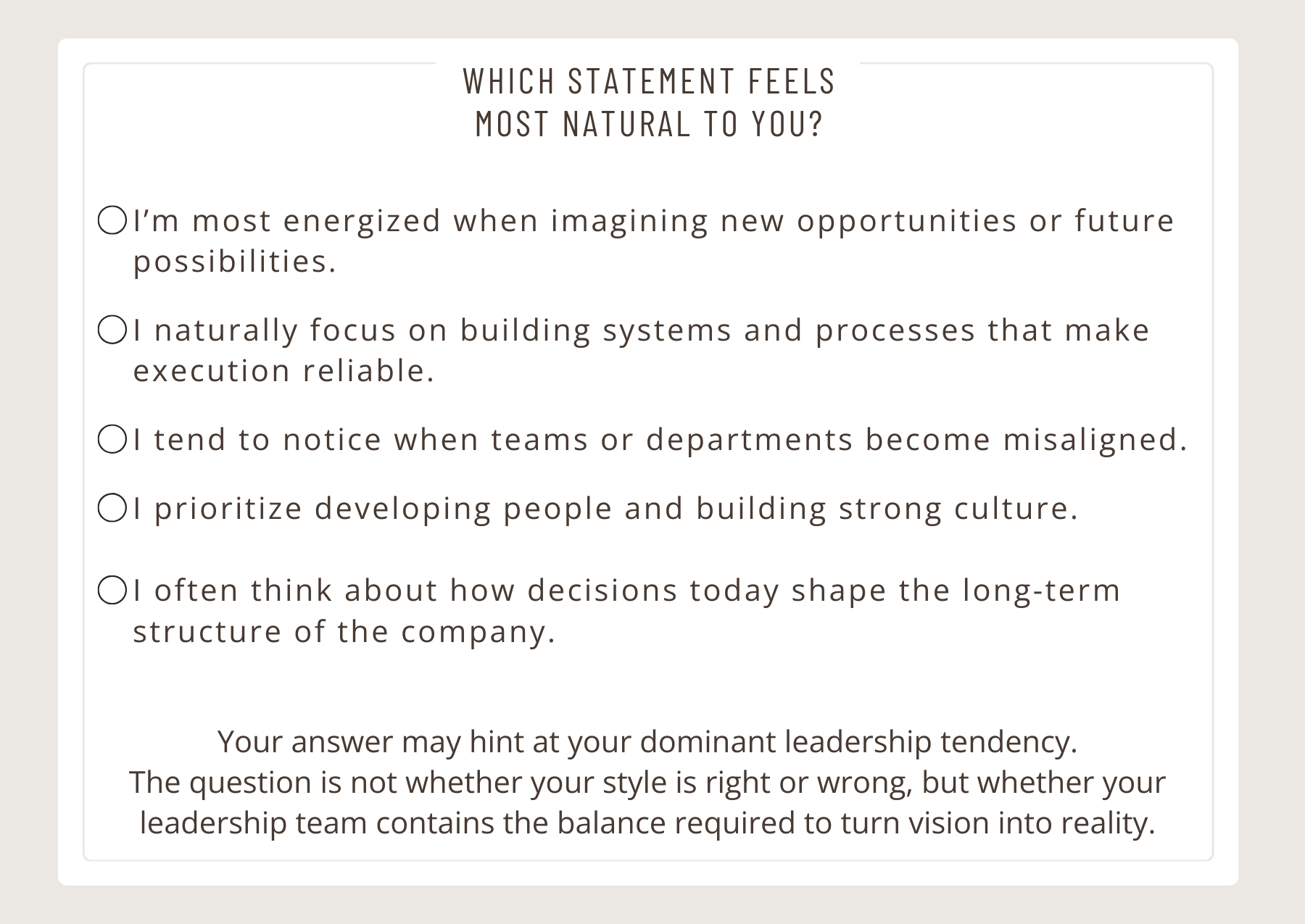
It begins with self-awareness and understanding how you lead.
The Visionary Leader
Some leaders naturally operate from possibility.
They are energized by ideas, new markets, emerging trends, and bold ambitions. Visionary leaders tend to think in terms of what could exist rather than what already does.
This mindset is often what gives birth to companies in the first place. A visionary leader can see opportunities others overlook and inspire people to pursue something that does not yet exist.
Many iconic founders embodied this trait. For example, Steve Jobs was widely recognized for his ability to imagine products and experiences long before the market demanded them. His vision shaped the direction of Apple in ways that defined entire industries.
Visionary leaders are powerful catalysts for innovation. But their strengths can also introduce blind spots.
Because they think far ahead, visionaries may lose patience with the operational details required to bring ideas to life. Teams may struggle to keep pace with constantly evolving priorities, or execution may suffer if the organization lacks operational discipline.
Vision creates momentum, but vision alone rarely builds sustainable companies.
The Strategic Operator
Where visionary leaders imagine what could exist, strategic operators focus on how to build it.
These leaders thrive on structure. They think in terms of systems, processes, timelines, and measurable outcomes. Their instinct is to turn complexity into organized execution.
A widely recognized example is Tim Cook. Before becoming CEO of Apple, Cook built his reputation through operational excellence, particularly in supply chain management. Under his leadership, Apple refined its global operations and became one of the most profitable companies in the world.
Strategic operators bring discipline to growth. They build the mechanisms that transform ambitious ideas into consistent results.
But operational leaders face their own risk. In environments dominated by systems and efficiency, organizations can become so focused on execution that they miss new opportunities or fail to adapt to changing markets.
Execution creates stability. Without vision, however, stability can become stagnation.

The Servant Leader
Another style centers on people rather than strategy.
Servant leaders focus on building environments where teams can perform at their highest level. They emphasize trust, support, and empowerment, often prioritizing the development of others over personal authority.
One widely cited example is Satya Nadella, whose leadership at Microsoft is frequently associated with a shift toward empathy, collaboration, and cultural renewal. Under his leadership, the company moved away from internal competition toward a more cooperative culture.
Servant leadership can produce highly engaged teams and resilient organizations.
However, like any style, it carries potential limitations. Leaders who focus heavily on consensus and empowerment may struggle when rapid or unpopular decisions are required.
Strong cultures still require decisive leadership.
The Founder-Architect
Some leaders combine vision with structural thinking.
The founder-architect style focuses on designing organizations intentionally, not just building products or pursuing growth. These leaders think about how decisions, systems, and culture interact to create long-term resilience.
Rather than reacting to growth, founder-architects attempt to shape it.
For example, Jeff Bezos famously designed leadership principles and decision frameworks within Amazon that guided how teams made choices as the company scaled. His emphasis on mechanisms and long-term thinking reflects an architectural approach to leadership.
Founder-architects tend to think in terms of structures that outlast individual leaders, but even this approach has tradeoffs. When leaders focus heavily on structure, organizations can become rigid if those systems are not periodically reexamined.

Why Leadership Balance Matters
Early-stage companies are often dominated by a single leadership style, typically the founder’s. In the beginning, that makes sense. Startups require conviction, speed, and a clear vision to survive, but as companies grow, leadership complexity grows with them.
Vision must be translated into strategy. Strategy must be translated into execution. Execution must be aligned across teams.
Rarely does one leadership style excel at every stage.
This is why many successful organizations pair visionary founders with operational leaders who excel at building systems and managing complexity.
When these complementary strengths are aligned, companies gain both direction and discipline.
Without that balance, organizations often experience familiar problems: brilliant ideas that never scale, operational machines that stop innovating, or cultures that struggle with clarity.
The Self-Awareness Advantage
The goal of understanding leadership styles is not to place yourself in a rigid category.
Most leaders operate with a blend of tendencies.
But recognizing your dominant instincts can be powerful. It allows you to identify both your natural strengths and the areas where support may be needed.
A visionary founder may need an operational partner to translate ideas into scalable systems. A highly operational leader may benefit from surrounding themselves with creative thinkers who challenge assumptions.
Leadership maturity often comes from learning when to lean into your strengths and when to compensate for them.
For early and growth-stage founders, this insight can shape hiring decisions, partnership structures, and even board composition.
The companies that endure are rarely built by leaders who try to do everything themselves.
They are built by leaders who understand how they lead — and intentionally surround themselves with people who complement that style.