









The Capacity Trap: Why Priorities Fail Without a Scheduling System
Ciera Peters | The Liquidity Journal | Q3 2026
In This Article:
The Myth of the Empty Calendar
Capacity Is a Business Resource
Why Prioritization Alone Fails
Most business operators believe they have a prioritization problem. Their task lists are overflowing. Deadlines are slipping. Important projects remain unfinished while urgent requests consume the day. The natural response is to search for better productivity techniques, stronger discipline, or more sophisticated planning methods.
Yet prioritization is rarely the root issue. More often, the real problem is capacity. Every week begins with ambitious goals and carefully selected priorities. By Friday, many of those priorities remain untouched. Not because they weren't important, but because there was never enough realistic time available to complete them. Without understanding capacity, prioritization becomes wishful thinking.
The Myth of the Empty Calendar
One of the most common planning mistakes among entrepreneurs is assuming that every open hour represents productive capacity. A calendar may appear relatively clear, but that does not mean those hours are truly available for meaningful work.
Meetings consume time. Administrative responsibilities consume time. Emails, client requests, unexpected issues, travel, and interruptions all consume time. Personal obligations and recovery time matter as well.
The result is a disconnect between what leaders believe they can accomplish and what their schedules can realistically support.
This creates a cycle that feels familiar to many founders:
Create an ambitious task list.
Underestimate time requirements.
Overcommit.
Fall behind.
Carry unfinished work into the next week.
Repeat.
Over time, the issue begins to feel like a discipline problem when it is actually a planning problem. You have already identified what matters, the challenge is creating enough capacity to execute what matters.
Capacity Is a Business Resource
Business owners carefully monitor cash flow, inventory, staffing levels, and operational expenses. These resources receive attention because they are finite. Your time deserves the same treatment.
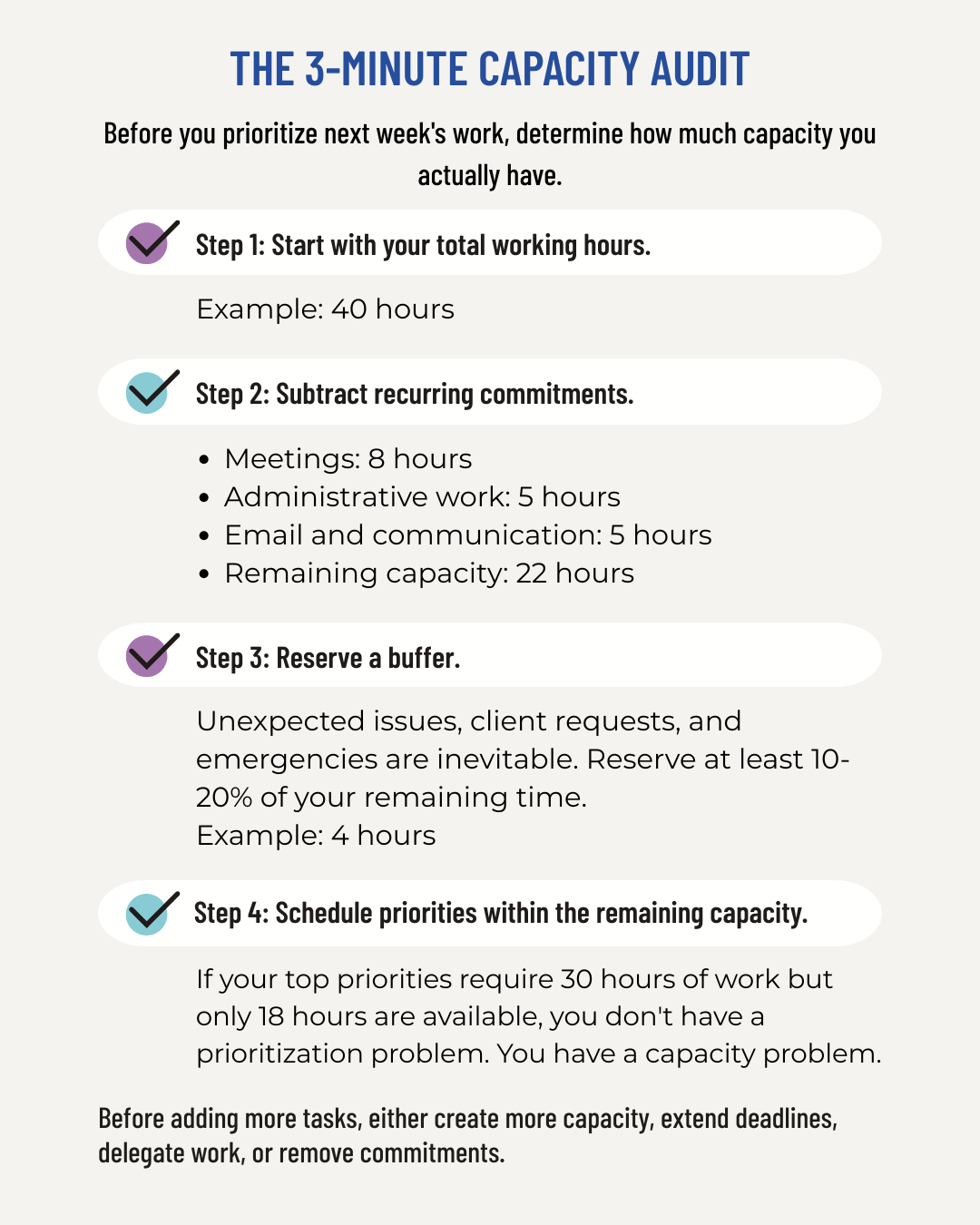
Capacity is simply the amount of work that can realistically be completed within a given period. Like any resource, it has limits. The problem is that capacity often feels invisible. There’s no dashboard warning leaders that they have allocated 70 hours of work into a 40-hour week. There is no automatic alert that says the current workload exceeds available time.
As a result, many business owners unknowingly create plans that cannot succeed from the start. When viewed through this lens, calendar management becomes less about productivity and more about resource allocation.
Cramming more work into the day won’t make you productive, matching commitments with available capacity will.
Why Prioritization Alone Fails
Most productivity systems begin with prioritization. Identify the most important tasks. Rank them. Focus on high-value activities.
These are worthwhile practices, but they usually stop short of the final step. A task can be important, strategic, and clearly defined. It can still remain unfinished if no realistic time has been allocated to complete it. Many leaders maintain extensive priority lists while simultaneously operating calendars that leave little room for focused work.
The result is predictable. The highest priorities continue to move from one day to the next while urgent but less important activities dominate available time. A task without time assigned is just an intention. Execution happens when priorities are connected to actual hours on a calendar. Without that connection, even the best planning frameworks struggle to produce results.
Turning Priorities Into Scheduled Work
The most effective execution systems combine two elements:
Capacity management
Priority management
Together, these create a realistic roadmap for getting meaningful work completed. This is where tools like FlowSavvy provide an interesting solution. Rather than treating task management and calendar management as separate systems, FlowSavvy combines the two. Tasks are automatically scheduled based on deadlines, priorities, and available working hours.
The first component is Scheduling Hours. Scheduling Hours allows users to define when work can realistically occur. Instead of assuming every hour of every day is available, users establish boundaries around their working time. This creates a more accurate picture of true capacity. This helps protect personal time, reduce overcommitment, and establish realistic expectations for what can be accomplished within a given week.
The second component is Task Prioritization. Once available capacity is defined, tasks can be prioritized according to importance and urgency. The platform then schedules work accordingly.
As deadlines shift or new commitments arise, tasks can automatically be reorganized based on available time and priority level. This eliminates much of the manual calendar maintenance that often accompanies traditional task management systems. More importantly, it reinforces a critical principle: Priorities should compete for available capacity, not exist independently of it.
Flowsavvy Auto Rescheduling
Building an Execution System
Whether using FlowSavvy or another planning framework, the underlying principles remain the same. Start by defining realistic working hours. Determine how much productive capacity actually exists within a typical week. Identify the projects and responsibilities that deserve attention.
Next, assign deadlines and priority levels. Then schedule those priorities within available capacity rather than assuming capacity will somehow expand to accommodate them.
Finally, review the system regularly.
Business conditions change. Priorities evolve. New opportunities emerge. A strong execution system adapts without requiring leaders to rebuild their plans from scratch every week. When priorities align with available capacity, execution becomes significantly more predictable.
Final Thoughts
Many business owners spend years searching for better prioritization methods when the real issue lies elsewhere. Priorities don’t fail because they are unclear, but because they are disconnected from capacity. Understanding what matters is important. Creating the time to execute on what matters is even more important. The leaders who consistently make progress are not necessarily the most disciplined or the busiest. They are often the ones who understand the relationship between capacity and execution, then build systems that align the two.
Recommended Resource
For business owners looking to implement these principles without manually reorganizing their calendars every day, FlowSavvy offers a practical solution. By combining scheduling hours, task prioritization, and automatic calendar management, it helps transform priorities into scheduled work that fits within real-world capacity. Learn more about FlowSavvy here.
Are you not already subscribed to our mailing list? Click here, or use the following link to get our articles delivered directly to your inbox: LiquidityJournal.com/Subscribe