




The Exit You Do Not Plan For Still Shows Up On Time
Randolph Love III | The Liquidity Journal | Q1 2026
Most business owners I meet can tell you their revenue model, their hiring plan, and the exact number they want the company to hit this year.
Ask a different question and the room gets quiet.
If something happened to you this weekend, who exactly buys your ownership interest on Monday?
That is not a morbid question. It is an operational one, because when an owner exits unexpectedly, the business does not pause like a streaming show. Payroll still runs. Customers still call. Vendors still want to be paid. And your family still needs groceries, tuition, and a plan.
A buy-sell agreement is the business version of a fire drill. You do not create it because you want the fire. You create it so nobody panics when the alarm goes off.
The problem no one wants, but every business eventually meets
When there is no plan, ownership becomes a loose object in a storm.
Your partners may want continuity. Your spouse may want cash. A key employee may want the company. An outside buyer may smell opportunity. Meanwhile, the business is trying to keep its footing while everyone pulls in a different direction.
That is how good companies get destabilized. Not because the product failed, or because the market changed, but because the ownership story was never written down.
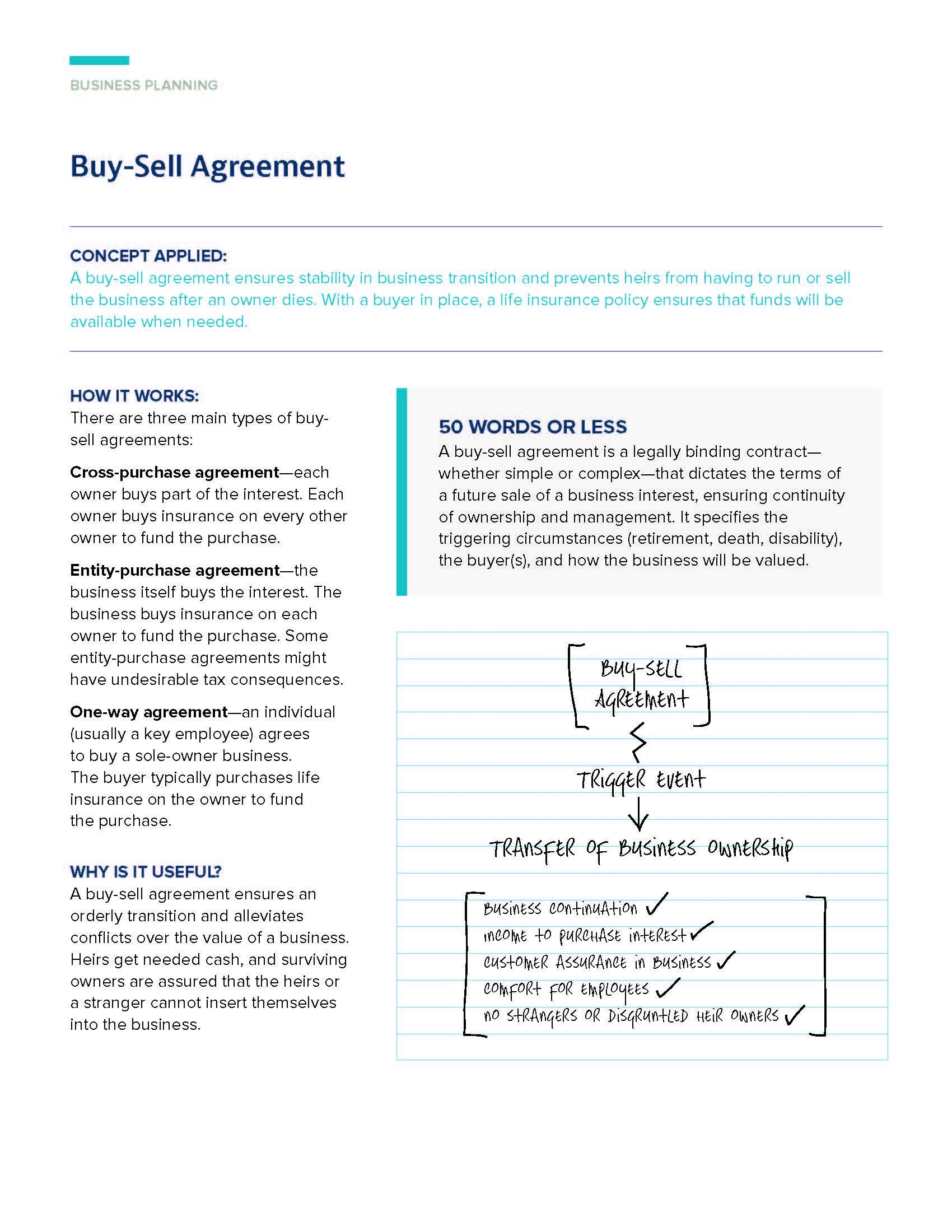
A properly structured buy-sell agreement is designed to stop that tug of war before it starts. It creates an orderly transition, reduces conflict over value, and protects the continuity of leadership.
The secret sauce is not the contract. It is the cash.
Here is the part many owners miss: a buy sell agreement is not a handshake about intentions. It is a legally binding blueprint that spells out the triggering events, who the buyer is, and how the business will be valued.
But a blueprint does not build a house. Money builds the house.
That is why buy-sell planning is often paired with life insurance funding. The goal is simple: cash is available when it is needed, not months later after delays, disputes, and stress have chewed up time and momentum.
Think of it like a relay race. The agreement is the rulebook for how the baton gets passed. The funding is the next runner already in position, ready to move the moment the handoff happens. Without funding, the “agreement” can turn into a nice idea that fails the first time it gets tested.
Three common ways owners structure the handoff
There are multiple ways to structure a buy sell agreement, but most business owners land in one of three lanes. Each lane answers the same question, just with a different buyer.
1) Cross purchase agreement
In a cross purchase arrangement, the surviving owners buy the departing owner’s interest. It is often funded by having each owner purchase life insurance on the other owners.
This is the neighbors on the block model. If one household has to move suddenly, the remaining neighbors already agreed on how the house gets bought and who writes the check. It can work extremely well, especially with a small number of owners, but it can become administratively heavy as the ownership group grows.
2) Entity purchase agreement
In an entity purchase arrangement, the business itself agrees to buy the departing owner’s interest. Typically, the company purchases life insurance on each owner to fund the buyout.
This is the spare tire in the trunk model. If a wheel comes off, the vehicle does not stop and argue about whose job it is to fix it. The business installs the replacement and keeps moving.
This structure can be clean and efficient, but tax details matter, and the right setup depends on the company’s specific facts. This is one of those places where good legal and tax coordination is not optional.
3) One way agreement
A one way agreement is common for a sole owner business where a specific buyer, often a key employee, agrees to purchase the business. The buyer typically purchases life insurance on the owner to fund the purchase.
I call this the chosen successor model. It is the cleanest storyline because it names the hero before the movie gets intense. It also protects employees and customers from the uncertainty of “who is in charge now” when the owner is no longer present.
What a buy sell agreement really protects
The obvious benefit is business continuation. The less obvious benefits are the ones that keep families and teams from breaking apart.
A well designed buy sell agreement helps ensure that heirs receive cash rather than being forced into the role of accidental operator. It helps surviving owners avoid sudden, unplanned co owners who may not share the business vision. It provides reassurance to customers, employees, and vendors that the company has a plan and will keep delivering.
If you have ever watched a company lose momentum because leadership changed unexpectedly, you already know this truth:
Markets tolerate change. Teams tolerate change.
What they do not tolerate is uncertainty.
A buy sell agreement is a machine designed to remove uncertainty.
The first step most owners skip: knowing what the business is worth
Every buy sell agreement eventually collides with a number.
What is the business worth?
And how will that value be determined when emotions are high and time is short?
Most owners have never had a real conversation about valuation outside of a casual guess. That is like buying homeowners insurance without knowing whether you are insuring a condo or a mansion.
Valuation does not just support the agreement. It gives the agreement a spine.
Before you argue about structure, funding, or legal language, take the simple move that gives everything else traction:
Get an informal business valuation, not because you are selling tomorrow.
Because you are planning like an owner who understands that the calendar does not ask permission.
A simple way to think about it
If your business is a plane, then:
The buy sell agreement is the emergency protocol.
The funding is the fuel that allows the protocol to work.
The valuation is the instrument panel that tells everyone the plane’s true altitude.
Without the instrument panel, people will argue about where they are. Loudly.
With it, they can make decisions that keep everyone safe and keep the business moving forward.
Your next move
If you are a business owner, partner, or founder, and you have never formalized your “what happens if” plan, take the first step. Get a no cost, informal business valuation.
That single action does three things immediately:
It forces clarity.
It gives your attorney and CPA something real to work from.
It turns buy sell planning from a concept into a strategy.
You can start that process here: https://shieldwolfstrong.com/valuation
This article is for general information only and is not legal, tax, or accounting advice. Consult qualified professionals for advice specific to your situation.


