







The Retirement Math Most People Miss, and Why Knowing the Source Changes Everything
Randolph Love III | The Liquidity Journal | Q1 2026
I did not come to The Liquidity Event in Jacksonville to sell a product. I came to clean up confusion (you can watch the full presentation here).
I started with a principle I live by: all truths parallel. What is true and workable in one area of life is usually true and workable in another.
You do not just eat any food. You check the source.
You do not just drink any water. You check the source.
So why would you accept financial guidance without checking the source of the knowledge?
Before I shared anything that night, I told people who I am and where my information comes from. I am Randolph Love III. I am the Founder and President of ShieldWolf Strongholds. I hold multiple financial and insurance designations and I am a registered pre-licensing and continuing education provider with the Florida Department of Financial Services. I have taught over a thousand adult students over the past few years and I have nearly two decades of experience in the insurance and financial services industry.
Then I gave the disclaimer clearly and loudly: I am not an attorney. And what I was sharing was information, not advice. No lawsuits tonight.

Two Couples, Same Savings, Two Completely Different Endings
I like to start with trivia because it exposes assumptions.
I asked the room to imagine two married couples. Both retire with $500,000 in investments. Both withdraw about 5% per year. Both average around a 6% return. Both adjust for inflation.
Then the twist: at age 78, one couple has a negative balance and the other couple has over a million dollars.
How is that possible?
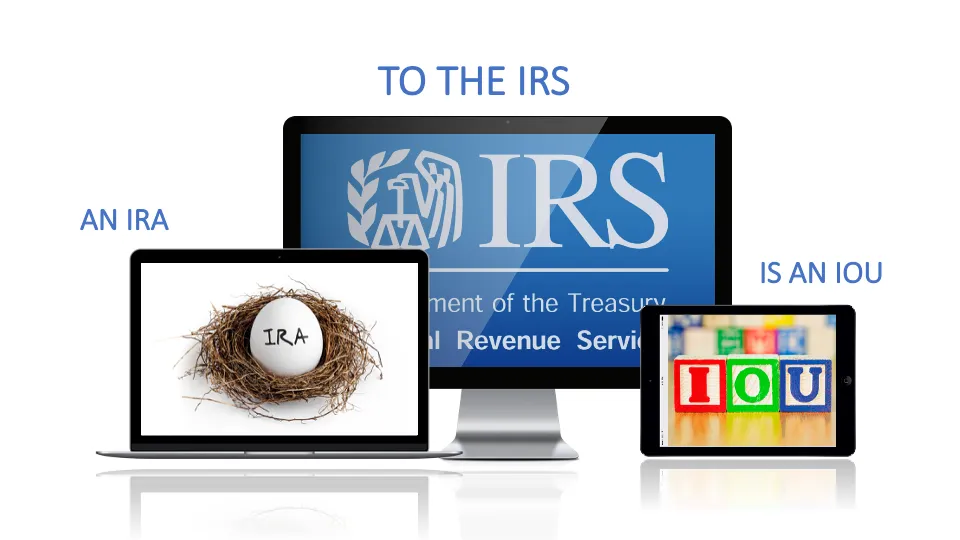
My first hint was simple: who is the worst business partner? The IRS.
I told the room to picture a “business partner” who demands you do all the work, take all the risk, put up all the money, and then claims a cut of the profits. Not only that, this partner can change their cut whenever they want.
Nobody would voluntarily sign that partnership agreement. But many people unknowingly do it through retirement planning that ignores taxes, ignores distribution strategy, and assumes the IRS will politely stay out of the way later.

Nobody Gets Robbed on the Way to the Bank
I explained that the government is patient. They often wait until retirement when you are leaving the bank.
That is what required minimum distributions are. You can be the best steward of your money, but once you reach a certain age, you may be forced to pull money out of tax-deferred accounts. That withdrawal becomes taxable income.
Then I asked a question that always changes the temperature in the room: how many of you knew your Social Security can be taxed?
A lot of people think that is inevitable. It is not always inevitable. There are legitimate ways to reduce what the IRS calls provisional income, which can reduce or sometimes eliminate the taxation of Social Security benefits. The goal is not to be shady. The goal is to be smart.
As I have gotten older, I have learned life is counterintuitive. The broker you are, the more you want it to look like you are making money on paper. The wealthier you are, the less you want it to look like it on paper.
Compounding Is Powerful, and Taxes Can Cripple It
I gave the room a fast math example:
If you double $1 twenty times, you reach $1,048,576.
That is the power of compounding.
Now add taxes to the equation and watch what happens. Tax drag does not just reduce your money. It reduces what your money can become. That is why one of the first questions I want people to ask is not “what is my return,” but “what is my return after taxes, fees, and inflation.”

The Quiet Killer: Losses
Next, I walked everyone through something most advisors do not explain clearly enough.
If you have $100,000 and you go up 50%, you reach $150,000.
If you then go down 50%, you are at $75,000.
That is not “back to even.” That is down 25%.
Whatever you lose, you often need at least double that percentage to recover. If you lose 50%, you need 100% to break even.
That is why average returns can be misleading, especially in retirement when you are withdrawing income. Sequence matters. Losses matter. The order matters.
Lock In and Reset
This is where I introduced what I call lock in and reset.
I am not interested in retirement strategies that leave people exposed to market losses with no real protection. I want people to understand there are ways to structure financial tools so that down years do not permanently damage the account value used for retirement income planning.
Some people hear about caps and say, “Why would I accept an 11% cap if the market can do 32%?”
Because a 32% year does not impress me if you are still digging out of the hole created by a prior down cycle. A plan that survives volatility is often more valuable than a plan that wins the marketing contest.
The Baking Soda Lesson: Stop Debating What It Is and Start Evaluating What It Does
I gave a simple example that people always remember.
I asked, “What creative things can you do with baking soda?” People said cleaning, deodorizing, brushing teeth, mouthwash, fridge odor neutralizer, laundry whitening, kitchen cleaner, volcano science projects.
Then I pointed out something obvious: most people never mention what baking soda was made for. It was made for baking.
And that is the point. Do not think about what something is. Think about what it does.
If I told you there was a strategy where your money could be liquid, accessible within one to three days, safer from market losses, positioned for a predictable rate of return, and structured for tax advantages, most people would want it.
But the moment I say “life insurance,” some people say, “I don’t need life insurance.”
I get it. That is why I told the room to stop reacting to labels and start evaluating function.
Access: Borrowing Against Cash Value
One of the most important questions people ask is, “How do I access the money?”
The common answer is borrowing. And the common reaction is, “I don’t like borrowing.”
People dislike borrowing because of interest and repayment. So I explained how policy loans work in properly structured scenarios. In many cases, you are not “withdrawing your money.” You are using your policy value as collateral. Depending on policy design, your accumulated value may continue to earn credited interest while you access cash through a loan.
I also explained the practical reality: if you never repay the loan, the balance is typically settled from the death benefit. Whatever is outstanding is subtracted, and the remainder goes to your beneficiaries.
I also gave a cautionary strategy many people have never heard: if someone is done with a cash value policy and they surrender it, they can create a taxable event. Depending on the situation, borrowing can sometimes be a better exit path than surrendering. Context matters, and this is why I push people to learn the rules before making a move.
Why It Can Be Tax Advantaged
I explained that certain tax treatments are tied to specific sections of the Internal Revenue Code, commonly discussed in life insurance planning:
IRC 7702 relates to what qualifies as life insurance
IRC 72(e) is often referenced in discussions around how certain distributions are taxed
IRC 101(a) is commonly referenced regarding death benefit treatment
I also addressed Modified Endowment Contracts (MECs). If a policy becomes a MEC, the taxation rules for accessing money can change significantly. The design and funding strategy matters, and it is not optional.
The Five-Story Building
To make proper funding easier to visualize, I used a metaphor.
Imagine owning a five-story building, but the rule is you can only rent out one floor the first year, then two floors the second year, and so on. The first years feel expensive and slow.
But once you get through the first phase, it becomes a long-term cash-flow asset.
That is how proper structure and funding can work in certain strategies. The early years require discipline. The later years can create options that most people do not realize are possible.

Whole Life vs IUL: The Chrysler 300 vs the Bentley
I do not call whole life “bad.” I call it different. But I do believe it is often oversold as something it is not.
When I was younger, I used to think the Chrysler 300 looked like a Bentley. Then one day I saw them parked next to each other, same color, side by side.
A Chrysler 300 looks nothing like a Bentley when you compare them directly.
That is what happens with policies too. Two options can sound similar until you compare cost structure, flexibility, and performance mechanics.
I also gave the room a simple way to test whether a policy is doing what it should: request an in-force illustration and calculate the internal rate of return by comparing total premiums paid to available cash value. Run the math. Do not rely on vibes.
And if something is underperforming, people should know about 1035 exchanges, which can allow you to move from one life insurance policy to another under certain rules without triggering immediate taxation. Again, structure matters.
My Closing Message: Tools Mean Nothing Without the Swing
Toward the end, I told the room something I believe deeply: everything is a tool.
Put a chainsaw in the hands of a skilled arborist and you can cut down a tree cleanly. Put it in the hands of a baby and you have tragedy and lawsuits.
A strategy is a tool. A policy is a tool. A retirement account is a tool.
The difference is not the tool. The difference is the skill behind it.
If I offered you Tiger Woods’ clubs, you would take them. But what you really want is his swing. That is why I push education so hard. That is why I tell people to know the source.
Yes, a lot of agents out there are Chrysler 300s. They will get you from A to B. But if you are building real wealth protection and real retirement options, you should want Bentley-level structure and execution.
My name is Randolph Love III. And my goal is simple: help business owners, franchise owners, and retirees build strategies that prioritize tax efficiency, protect against market losses, and create liquidity and options. Not hype. Not hope. Options.
Watch the full presentation here:


