







When the Insurance Claim Process Feels Like a Maze, Clarity Becomes Currency
Randolph Love III | The Liquidity Journal | Q2 2026
There is a certain kind of panic that follows property damage.
It arrives quietly at first. A patch of missing shingles. Water finding a path where it does not belong. A tree branch that looks small from the street and catastrophic from the living room. Then comes the second storm, the one that does not come from the sky at all. It comes from uncertainty.
What do I do first?
Who do I call?
What does my policy actually say?
And how do I know whether the answer I received is the right one or simply the first one?
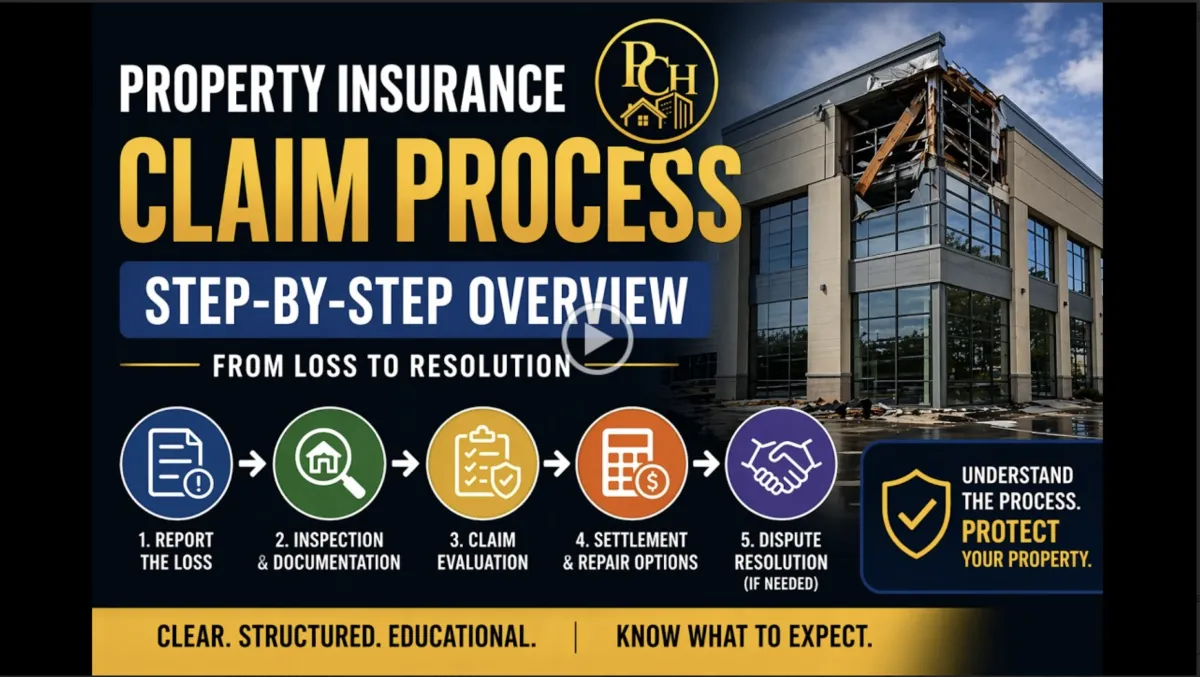
I recently watched a video by Darrick O'Day, public adjuster, insurance appraiser, and insurance umpire, titledInsurance Claim Process Explained (Step-by-Step Overview). What struck me was not just the information itself, but the order he brought to a subject that often feels disordered. He did something many people in the property world fail to do. He laid out the insurance claim process in a way that property owners can actually follow.
That matters.
Because when a roof is damaged, a building is exposed, or a business owner is trying to protect a property that supports livelihoods, confusion is expensive. In those moments, clarity is not just comforting. It is valuable.
O'Day’s explanation starts from a simple premise. In an ideal world, a property owner experiences a loss, inspects the damage, files the claim, the insurance company investigates, and a sound claim decision follows. If the claim is covered, the repairs move forward. If the denial is correct and supported by the facts and the policy, the matter ends there.
That is how the process is supposed to work.
But as anyone who has lived through a property claim knows, the real world is rarely that tidy. Insurance claims are often less like a straight hallway and more like a house filled with unfamiliar doors. One opens to policy language. Another opens to contractor scope. Another opens to exclusions, endorsements, deductibles, and repair methodology. It is possible to be standing in your own kitchen and still feel like a stranger in your own claim.
That is where O'Day’s guidance becomes especially useful.
He explains that once a loss occurs, the property owner must do more than simply notify the insurer. There are obligations after the loss, often called duties after loss. One of the most important is mitigation. If shingles are blown off, you may need a tarp. If a tree lands on the property, it may need to be removed. In other words, the policyholder cannot simply stand in the rain and hope the contract will hold an umbrella for them. Action matters.
From there, the process becomes more technical.
If the insurer’s position does not align with what the property owner believes is owed, O'Day explains that the next step is not outrage. It is organization. Demand a certified copy of the policy. Read the entire policy, not just the declarations page or the paragraph you hope will save the day. Determine the direct physical loss. Determine the reasonable method of repair. Work with qualified contractors to understand code requirements, material availability, and market-based repair costs. Then go deeper. Study the policy language, the exclusions, and the endorsements that may restore coverage where an exclusion seems to take it away.
This is where many claims begin to separate the prepared from the frustrated.
Too many policyholders assume the claim is a conversation when in fact it is also a record. It is a file. It is evidence. It is documentation. It is valuation. It is interpretation. It is often a proof of loss package that must stand up under scrutiny. A claim, in that sense, is a little like building a case brick by brick. Miss enough bricks and eventually the wall cannot carry the weight.
This is also the point at which humility becomes wisdom.
One of the most important takeaways from O'Day’s presentation is that property owners may benefit most not by trying to become instant experts themselves, but by working with qualified professionals such as a public adjuster or insurance appraiser when the situation calls for it. There is no medal for navigating a complex claim alone if the result is a weaker presentation, a missed duty, or an underpaid loss.
We do not expect property owners to become roof engineers overnight. We should not expect them to become policy interpreters overnight either.
That does not mean owners should be passive. Quite the opposite. They should stay engaged, informed, and disciplined. But there is a meaningful difference between being engaged and being alone. A strong professional advocate can help translate the language of damage, scope, and valuation into something the claim process can properly absorb.
O'Day also makes an important distinction that many owners miss: a partial denial is not the same thing as a full denial.
This is the kind of distinction that looks minor on paper and proves major in practice.
If a carrier acknowledges covered damage but pays less than what is needed, even if the amount falls below the deductible, that can still represent a partial denial. If the carrier says there is no covered loss at all, that is a full denial. Those are different animals, and different animals require different handling. Treating them as though they are the same is like bringing a flashlight when what you really need is a compass.
If the insurer’s decision is sound, the claim may be over. But if the decision is wrong in part or in whole, O'Day points to the next rational step: demand warranted revisions. Review what was submitted. Review what was omitted. Review how the insurer interpreted the facts. Gather additional evidence if necessary. Then present a more complete, more supported position.
If agreement still cannot be reached, the path may move toward appraisal, litigation, or another contract enforcement process depending on the jurisdiction and policy. Again, this is where local and licensed guidance becomes essential. Insurance is national in conversation, but deeply local in practice.
For restoration contractors and public adjusters, there is an additional lesson here.
The best professionals do more than complete the work. They interpret the chaos for the people living through it.
Contractors often help establish repair methodology, code considerations, material realities, and market pricing. Public adjusters help shoulder the administrative and interpretive burden that can overwhelm a property owner. The best professionals in both categories do more than perform tasks. They bring structure to chaos. They help turn a frightened policyholder into an informed participant.
That is no small thing.
In every field, there are moments when people do not just need service. They need steadiness. After property damage, steadiness may be the most underrated asset in the room.
At its core, this is what I appreciated most about Darrick O'Day’s explanation. He did not promise shortcuts. He did not present the claim process as effortless. He presented it as something that can be understood, and because it can be understood, it can be approached with more confidence and less fear.
That is a powerful gift.
A property claim is never just about shingles, estimates, and paperwork. It is about whether people can move from disruption back toward normalcy. It is about whether a family can protect its home, whether a business can protect its operations, and whether a policyholder can stand on the contract they paid for with discipline rather than desperation.
In life, as in business, we often discover that peace does not come from avoiding hard processes. It comes from understanding them well enough to move through them wisely.
That is why I believe this conversation matters.
If you own residential or commercial property, support policyholders, or work in restoration or advocacy, watch the full video of Darrick O'Day’s explanation of the process. In a space where emotion often outruns understanding, his framework offers something rare and valuable: a map.
And when the storm has already passed but the claim battle has just begun, a map can feel a lot like mercy.


